Construction Testing Services
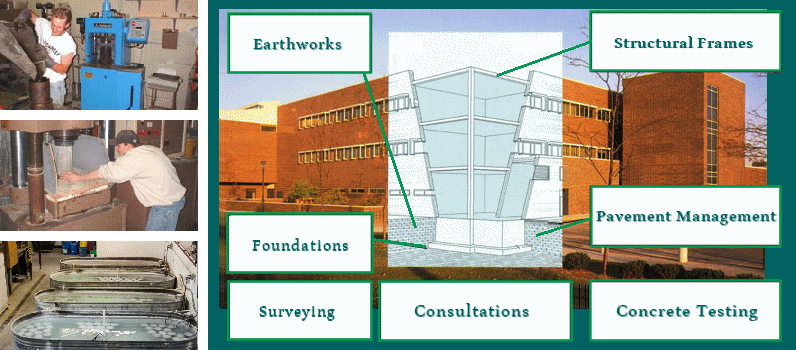
Earthworks, Structural Frames, Foundations, Pavement Management, Surveying, Concrete Testing, Consulting.
Our field technicians and professional engineers have undergone years of extensive training to acquire their level of construction testing expertise.
We take great pride in the accomplishments and experience our technicians and engineers have acquired some of the most pertinent professional certifications being earned from...
| Organization | Program or standard | Relevance to this work |
|---|---|---|
| WisDOT Highway Technician Certification Program (HTCP) (opens in a new tab) | PCCTEC-I, CST, NUCDENSITY-I, GRADINGTEC-I, AGGTEC-I, TMS, HMA-IPT, HMA-MD | WisDOT standard specification 701 requires HTCP-certified personnel for contract sampling and testing |
| American Concrete Institute (opens in a new tab) | ACI Grade I certification | Concrete field testing; HTCP offers a course-fee discount to technicians holding ACI Grade I within three years |
| Association of Construction Inspectors (opens in a new tab) | Construction inspection standards and recognition | Professional organization for construction inspection and project management |
| American Welding Society (opens in a new tab) | Professional certifications for inspectors and supervisors | Welded connection inspection for structural frames |
| International Code Council (opens in a new tab) | International Codes (I-Codes) | Basis of the Wisconsin Commercial Building Code, including IBC Chapter 17 special inspections |
| Troxler Electronic Laboratories (opens in a new tab) | Nuclear density gauges, gyratory compactors, ignition ovens | Equipment manufacturer whose gauges are widely used for in-place density testing |
| Wisconsin Department of Transportation (opens in a new tab) | Standard Specifications, Construction and Materials Manual | Governs highway materials testing and quality management programs |
The technical expertise, personal attention to detail, rapid response to resolving coordination conflicts, testing accuracy and the individual care and attention to client concerns that our technicians and engineers bring to each project is what sets CGC, Inc. apart from our competition.
- Earthwork Testing
-

Earthworks Testing Testing ensures the soil upon which construction occurs is well prepared and stable for the lifetime of the construction.
- Compaction monitoring
- Proctor Curve development
- Fill type consultation
- More...
- Foundation Consulting
-

Foundation Consulting CGC offers consultation during construction on all types of shallow and deep foundations, spread footings, compacted aggregate piers, mats, piles and drilled shafts.
Field personnel perform subgrade observations to compare the soil profile determined by subsurface borings with actual conditions.
Soil or rock subgrades supporting shallow foundations are evaluated for load-bearing capacity and potential for settlement. Deep foundations require careful observation of installation techniques, driving resistance and soil/rock characteristics to ensure expected performance is achieved.
CGC has more than 75 years of collective experience in civil and geotechnical engineering. We have literally performed thousands of foundation observations for many types of structures including single story and high-rise buildings, parking ramps and structures, wastewater treatment plants, industrial sites, wind farms and power plants.
- Spread footings and mats
- Subgrade improvements
- Piles and drilled shafts
- Compacted aggregate piers
- More...
- Construction Surveying
-

Construction Surveying The "lay-out" or "setting-out" of reference points and markers guide the construction of new structures such as roads or buildings.
- Building and facility layout
- Construction staking
- Pay item measurement
- Construction surveying
- More...
- Specialty Consultations
-

Specialty Consultations CGC staff are fastidious about focusing their attention during the review of the material properties of earth that will support your construction project.
Site properties of soils and rock all the way to bedrock are investigated to determine and ensure all engineered properties of materials meet the obligations of the construction project.
- Construction materials lab testing
- Dewatering analysis and recommendations
- Construction administration
- Earth retention
- Stormwater infiltration
- More...
- Structural Frame Testing
-

Structural Frame Testing Cold-formed steel connectors embedded in concrete to Cast-in-place Proprietary Bolts in concrete; all such types of components must be tested and scrutinized to ensure the design of construction elements meets or exceeds engineered performance standards and specifications.
- Testing of bolted and welded connections
- Fireproofing
- PT tendon tensioning
- More...
- Pavement Management
-

Pavement Management The objective of pavement management is all about the practiced mastery of the process of managing life cycle costs.
- Subgrade stabilization consultation
- Base course testing
- Testing of asphalt and concrete pavements
- Pavement evaluation and maintenance
- More...
- Concrete Testing
-

Concrete Testing The quick response, accuracy, individual attention and clearly communicated results of CGC staff are some of the features that set our concrete testing services apart from our competition.
Our on-site staff will sample and test concrete for slump and air content, working with you on a day-to-day basis to document the quality of your work materials.
CGC will also cast your cylinders, properly cure them on-site and transport them to our Dane County or Milwaukee County testing facilities where certified staff will perform compressive strength testing.
In addition, beams can be cast for flexural strength determination at either of our testing facilities. Test results are written in easy to understand terms and reported immediately via email.
For ongoing projects CGC performs in-depth statistical analyses to identify strength variations and fine-tune your concrete mix.
Non-destructive test methods are available for special applications. To allow concrete form removal at the earliest possible time, CGC will monitor compressive strength gain with age using the Maturity Method. The Windsor Probe® and other non-destructive tests are also used, most frequently to gauge the in situ strength of mature structures.
CGC has over 75 years of collective experience in civil and geotechnical engineering. Our firm has completed thousands of projects with normal-strength and high-strength concrete for highways, industrial and commercial structures including single-story, multi-story and high-rise residential construction.
- On-site sampling and testing
- Compressive strength testing
- Non-destructive testing
- Maturity Method testing
- Windsor Probe testing
- More...
Test Methods and Certifications Behind CGC Construction Testing
WisDOT’s 2025 Standard Specifications, section 701, set the personnel, laboratory and documentation rules that govern contract materials testing. Personnel must be HTCP-certified at or above the level in table 701-1, commercial laboratories must be qualified under the Wisconsin laboratory qualification program, control charts plot the running average of the last four QC data points, and the department performs at least one verification test for every five contractor QC tests.
| Test | Method | Minimum certification |
|---|---|---|
| Sampling freshly mixed concrete | WTM R60 | PCCTEC-I |
| Air content of fresh concrete | WTM T152 or WTM T395 | PCCTEC-I |
| Concrete slump | WTM T119 | PCCTEC-I |
| Concrete temperature | AASHTO T309 | PCCTEC-I |
| Making and curing concrete specimens | WTM R100 | PCCTEC-I |
| Concrete compressive strength | WTM T22 | Concrete Strength Tester (CST) |
| Concrete flexural strength | WTM T97 | Concrete Strength Tester (CST) |
| Liquid limit | WTM T89 | ATTS |
| Plastic limit and plasticity index | AASHTO T90 | GRADINGTEC-I |
| In-place soil density and moisture (nuclear) | WTM T310 | NUCDENSITY-I |
Sources: WisDOT 2025 Standard Specifications, section 701 (opens in a new tab); WisDOT Independent Assurance Program report (opens in a new tab). Methods are revised from time to time; confirm against your contract.
These certifications are widely held across the state’s materials testing workforce. The HTCP reported 459 PCCTEC-I, 272 NUCDENSITY, 126 CST and 120 Grading certifications in 2024 (HTCP presentation (opens in a new tab)). Our field technicians and professional engineers work to these methods on projects throughout Wisconsin from our Madison and West Allis facilities.
Special Inspections and the Wisconsin Commercial Building Code
As of September 1, 2025, Wisconsin’s Commercial Building Code (SPS 361-366) is based on the International Code Council’s 2021 codes and, for the first time, adopts International Building Code Chapter 17, Special Inspections (Wisconsin Architect, Fall 2025 (opens in a new tab)). The Department of Safety and Professional Services publishes guidelines for special inspections and minimum qualifications (opens in a new tab) for special inspectors, testing laboratories and laboratory technicians. Bolted and welded connection testing, fireproofing and post-tensioning observation are among the services we provide for structural frames.
Frequently Asked Questions About Construction Testing in Wisconsin
Which certifications does WisDOT require for contract concrete testing?
WisDOT's 2025 Standard Specifications, section 701, require sampling and testing to be done by personnel certified through the Highway Technician Certification Program (HTCP) at or above the level listed in table 701-1. Sampling fresh concrete, air content, slump, temperature and making and curing specimens require PCCTEC-I; compressive and flexural strength testing require the Concrete Strength Tester (CST) certification. No more than one assistant certified technician (ACT) may work under a single certified technician.
Which test methods apply to fresh and hardened concrete on WisDOT work?
Table 701-1 lists WTM R60 for sampling freshly mixed concrete, WTM T152 or WTM T395 for air content, WTM T119 for slump, AASHTO T309 for temperature, WTM R100 for making and curing specimens, WTM T22 for compressive strength and WTM T97 for flexural strength.
What does CGC do for concrete testing on a project?
CGC's on-site staff sample and test concrete for slump and air content, cast and cure cylinders on site, and transport them to the Dane County or Milwaukee County testing facilities for compressive strength testing by certified staff. Beams can be cast for flexural strength testing at either facility, results are reported by email, and on ongoing projects CGC performs statistical analyses of strength variation to help fine-tune the mix.
How is concrete strength monitored for early form removal?
CGC monitors compressive strength gain with age using the maturity method (ASTM C1074) so forms can be removed at the earliest safe time. The Windsor Probe and other non-destructive tests are used most often to gauge the in situ strength of mature structures.
Which HTCP certifications cover soil and compaction testing?
GRADINGTEC-I covers soil Proctor testing, textural classification and Atterberg limits. NUCDENSITY-I covers nuclear density testing; WisDOT's independent assurance program lists WTM T310 for in-place density and moisture content of soil and soil-aggregate by nuclear methods. For earthwork, CGC offers compaction monitoring, Proctor curve development and fill type consultation.
Does Wisconsin require special inspections under the International Building Code?
As of September 1, 2025, Wisconsin's Commercial Building Code (SPS 361-366) is based on the 2021 International Code Council codes and, for the first time, adopts IBC Chapter 17 Special Inspections. The Department of Safety and Professional Services publishes guidelines for special inspections and minimum qualifications for special inspectors, testing laboratories and laboratory technicians.
Reference Sources
- WisDOT 2025 Standard Specifications, section 701 General QMP Requirements (opens in a new tab)
- HTCP certifications and courses (opens in a new tab), University of Wisconsin-Platteville
- HTCP Construction Materials presentation, Wisconsin Transportation Builders Association (opens in a new tab)
- Wisconsin DSPS Commercial Buildings program (opens in a new tab)
- ASTM C1074, Estimating Concrete Strength by the Maturity Method (opens in a new tab)
Technical references last reviewed November 2, 2026 by: CSG